
Colorado Department of Agriculture
Metro Institute provides online computer-based testing services in Colorado for the Colorado Department of Agriculture. CDA proctored testing sites are conveniently located throughout Colorado. All persons desiring to be certified with the Colorado Department of Agriculture must first apply with CDA and pass an exam(s) in the appropriate category(s).
Testing Made Easy
Not registered to test?
If you have not been issued an CDA Testing ID number or have never tested at a computer based testing center you must apply with the CDA.
It fast and easy good luck!
Apply Now!
Already Approved to Test
If you have already applied and been issued an CDA Testing ID number and need to schedule or reschedule a test click the Schedule Now button below. It's fast and easy good luck!
Schedule Now
Find a Testing Center
Metro has a testing center network with conveniently located throughout Colorado. You get directions and print a map.
Click the button to find your location!
Locate
Online CEU's
Metro now offers convenient online Continuing Education Credits in your state! Timely and informative fully approved CEU videos.
Register and start watching!
Get Started!
Testing Info
Everything you need to know to get started.
Before you are eligible to test in Colorado you must submit an application and be approved by CDA. Visit www.metrosignup.com and create an account, submit an application and wait for an approval email.
Testing Procedure:
1. Complete the Exam Application
- The first part of the Metro Institute website provides information to CDA through an Online Exam Application. CDA will use this information to verify your CDA Pesticide Applicator ID number if you have one or to create a Pesticide Applicator ID number for you if you are new to the pesticide applicator examination process.
- CDA will send an e-mail to you confirming your CDA Applicator ID number - please write it down for future use. Continue on to step 2.
2. Schedule your Online Test
- The second part of the Metro Institute website is where you will start the test scheduling process.
- Choose your Testing Center location and time.
- You will be prompted to enter your name, applicator ID number, and password provided by Metro Institute.
- You'll be asked for some optional employer related information and any missing information. The information collected at this website is used to create a Metro account that allows you to schedule and pay for exams.
- Follow the prompts to choose your testing location and exams you wish to take.
- Pay all examination fees.
- Metro will e-mail you your receipt and confirmation of your date, time and location of your scheduled exam(s).
3. Note:
-
- All examinations must be paid for and scheduled online at least two days prior to testing. A test may not be scheduled and taken on the same day and must be taken at the scheduled location.
- Payment of $41.50 per test will be required at the time of scheduling Visa, MC, AX, or PayPal
- For security purposes, you must have a valid e-mail account to register for exams. Without a valid e-mail account, you will not be able to test.
- You must bring your Government issued valid (unexpired) photo ID to the testing site. You will not be allowed to test without proper photo ID.
- No reference materials are allowed in the examination area.
- If you cannot make your exam appointment for any reason, you may reschedule at no charge with 24 hours notice. Failure to provide the required cancellation notice will result in the forfeiture of you testing fees.
Schedule a Test Online - HERE
For support or assistance - Call "877-533-2900"

Helpful Testing Information:
1. You will have two (2) hours to take the Qualified supervisor or Certified Operator General examinations and one (1) hour for category exams. Most people are able to complete each test before time expires. Therefore, take your time and read each question and each of the possible answers very carefully. If the exam time expires your exam will end and be graded.
2. You may skip questions and return to them later. You may review any or all of the test questions as long as you have time remaining on the clock. If you forget to answer any questions before selecting the "Finish Test" button, you will receive one warning that you have unanswered questions. You may then answer those questions and then click the "Finish Test" button again to get your final score.
3. The passing score for all tests is 70 percent. For instance, on a test with 50 questions you could miss up to 15 questions and still receive passing score. However, if you miss 16 or more questions you will receive a failing score and then must re-schedule to take the test over again.
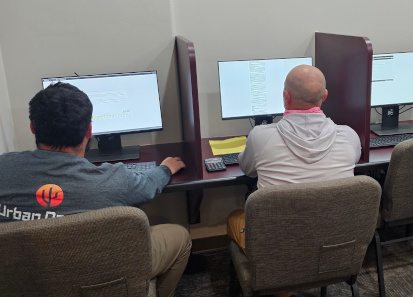
If you have any technical issues or questions regarding the testing interface notify the proctor for assistance. The test proctor cannot discuss test questions or provide any help with test content.
Study Guides
CEPEP produces the official study guides for all state exams. Study guides prepare pesticide applicators to not only take the exam, but to apply pesticides safely and effectively. People seeking a Qualified Supervisor or Certified Operator license must pass the general exam and at least one category exam.
Click on each study guide title below to learn more about that category and to order a copy from the CEPEP online store.
Note: Study guides for the new licensure categories that went into effect on January 1, 2024, can be found at:
- Aerial Applicators Manual may be downloaded for free.
- It may also be purchased through Colorado State University's website.
- The National Soil Fumigation Guide may be downloaded for free.
- It may also be purchased through Colorado State University's website.
-
The Non-Soil Fumigation Guide can be purchased through Colorado State University's website.

Reviewing Test Scores:
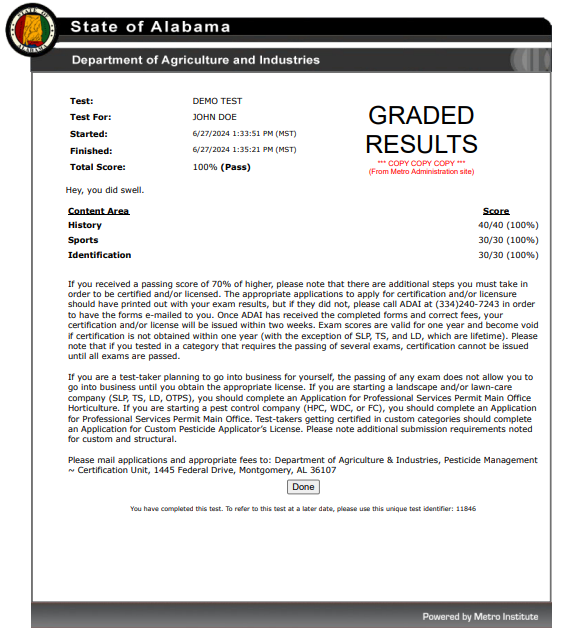
Once you complete the test, the proctor (test administrator) will provide you with a printed test result page. This page will inform you of your score (70% or greater to pass) and a summary of test “Content Areas”, the total of questions in that Content Area and the number of correct answers for the Content Area. For example: the exam had 10 pest identification questions and you answered 8 correctly. This can be useful information if you did not pass the test.
What Next?
Qualified Supervisor (QS)
An individual employed by or acting on behalf of a commercial, limited commercial, or public applicator who without supervision evaluates pest problems, recommends pest controls using pesticides or devices, mixes, loads, or applies any pesticide, sells any application services, operates devices, or supervises others in any of these functions must be licensed as a qualified supervisor. A Qualified Supervisor must meet specific on-the-job experience requirements in each category of licensure to obtain this license.
An applicant for a qualified supervisor license must:
- Successfully complete the general exam plus exams in all categories applicable to the pesticide applications which they will be performing
- Have the required experience and qualifications specified in rule
- Submit a properly completed application and the $100 license fee.
Certified Operator (CO)
An individual employed by or acting on behalf of a commercial, limited commercial, or public applicator, who uses restricted-use pesticides without the on-site supervision of a qualified supervisor must be licensed as a certified operator. There are no experience requirements to obtain this license.
An applicant for a certified operator license must:
- Successfully complete the general exam plus exams in all categories applicable to the pesticide applications which they will be performing
- Submit a properly completed application and the $100 fee, or apply for a reciprocal license.
Private Applicator (PA)
A person who uses or supervises the use of a restricted-use pesticide for the purpose of producing an agricultural commodity on property owned or leased by the applicator or the applicator's employer or, if the pesticide is applied without compensation other than trading of personal services between producers of agricultural commodities, on the property of another person must be a licensed private applicator.
An applicant for a private applicator license must:
- Successfully complete the private applicator exam
- Submit a properly completed application and the $75 license fee with the application and acceptable ID, such as a driver's license copy.
If you passed the passed the required exams for the license you are seeking visit the CDA Application portal:
CDA QSCO Pesticide Applicators License
The Department issues licenses to business and individual pesticide applicators. Additional information can be found in CDA's Pesticide Licensing and Examination Guide.
If you failed your exam, you may re-take that exam by following the same procedures. Please visit to Metrosignup.com to schedule another test.
For Questions or Assistance call Customer Service toll free (877) 533-2900
What to Expect at the Testing Center
Metro strives to provide a professional and pleasant testing experience for every examinee. Below you find some simple requirements and rules to follow before, during and after your exam. Not everything is covered here and your exam proctor may advise or remind you of the rules to begin and finish your exam.
Good Luck and thank you. If you have any questions or concerns regarding testing rules and procedures please call Metro Institute toll free at (877) 533-2900
Photo ID Required
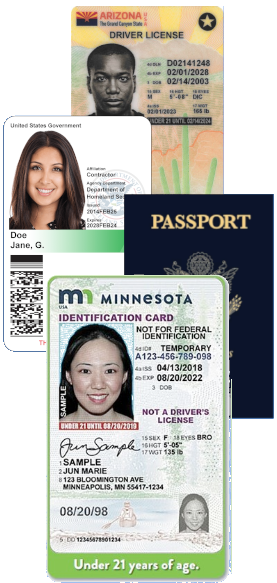
A test candidate must present to the test proctor a government- issued photo identification:
Acceptable ID includes original, unexpired, current photographic identification that clearly depicts the examinee, and is obtained from a governmental agency.
Examples include a state driver’s license, military identification, passport, state-issued identification card, or federal agency identification.
You will not be able to test without a qualifying ID.
Items Not Allowed in Testing Room
Examinee Personal Items
Maintaining exam integrity is one of the primary goals of a proctored exam. One of the ways exam integrity is achieved is by limiting the items allowed in the testing room. The method used to store personal items can vary by testing center. Examples of storage methods are: lockers, storage containers, or asking examinees to leave unnecessary items in their vehicle. All testing centers must provide some form of secure storage for car keys and other small items.
Items Not Allowed in Testing Room:
(This list is representative but is not exhaustive. Other items that are deemed to cause distraction to other examinees or put exam security at risk may be prohibited)
- Watches, smart glasses, fitness devices (e.g., Fitbits), cellphone, backpacks, purses, wallets, bags, sunglasses, food or drink, loose change, personal scratch paper, trading aids, pencils, pens, tissues, hats, earmuffs, scarfs, umbrellas, medications (inhalers or diabetic items are exceptions), personal laptops, keys, and work ID badges
- Regarding outerwear, coats and jackets should be stored or hung up outside of the testing room. Exception: Some vendors allow jackets to be placed on back of testing chair.
Items to be VISUALLY checked before an examinee is seated
• Glasses - Proctor must visually inspect the glasses of examinee.
• Jewelry - Solid or chunky jewelry must be visually inspected. Items that may cause noise or distraction must be removed.
• Pockets - Pockets of examinees must be emptied with all items placed in a locker or storage area. Examinees must be asked to pat their pockets to show all items have been removed. Some testing centers require that pockets be turned inside out.
(Please note: The proctor should never physically touch the examinee to determine that pockets have been emptied. This should be determined by visual inspection only.)
Other Considerations: • Backpacks - rolling or large bags that do not fit in storage area should be stored in vehicle. If that is not possible, it is recommended that valuables be removed and secured in the locker or storage area. Backpacks must be placed at a designated location with the understanding that the examinee is liable for any belongings. Examinee’s personal belongings must never be stored in the proctor area.
Examinee Disqualifications
All incidents (cheating, distraction, noise, unscheduled breaks etc.) will be reported as defined in processes below. Suspected cheating behavior on exams should be verified by at least two center staff persons whenever possible before action is taken.
• Examinees will be disqualified for cheating.
• Cheating includes, but is not limited to, copying questions or answers in any manner, talking with other examinees, referring to any notes while the exam is being administered, or being in possession of any items with documented questions, answers or notes or any other restricted materials.
• When an examinee is disqualified the exam will be terminated and the examinee will be asked to leave the testing center.
• The proctor should collect and retain any evidence or items relevant to the incident such as notes, study material or devices.
Incident Handling: All disqualifying incidents (cheating, distraction, noise, unscheduled breaks etc.) will be reported to Metro Institute and the governing agency.
• Metro will immediately notify the Agency Compliance Officer for incident review, penalty review and penalty enforcement as allowed by rule, regulation and law.
For customer service or technical support call (877) 533-2900
LET METRO HELP MAKE YOUR TESTING EXPERIENCE WONDERFUL AND SUCCESSFUL!
©
2026
Metro Institute Inc. Metroinstitute.com
Powered by Metro Institute MOS iCBT 3GB